

In every delegate meeting, executive committee meeting, and general membership meeting in Local 375, the word “Administratorship” is brought up. For every problem the Local faces today, the “administratorship” is cited as the cause, from poor financial management and the near-loss of our tax-exempt status, to weak member engagement and representation. It is invoked so often that leadership might have forgotten what it actually took to place under it. However, due to the same pattern of anti-democratic behaviors and despite blaming it for almost every problem, Local 375 leadership (having learned nothing) has put us at risk of being placed into another administratorship.
So, what was the administratorship? In 2016, AFSCME appointed an “administrator,” John English, who took over the daily operations of the Local in order to rectify previously established violations of the AFSCME constitution.
AFCME appointed English to run Local 375 after a fraught election, which had to be re-run, and a corrupt president who had attacked and silenced members. A slew of both frivolous and legitimate charges related to the election were filed with AFSCME. There are a few dozen articles and letters to the editor in The Chief by Mitch Feder, Claude Fort, Michael Troman and others documenting this tumultuous time. One article, penned, in part, by current Local 375 President Michael Troman, claimed one of the attack emails sent by the ousted former president Claude Fort (who was born in Haiti) accused Troman’s slate of “anti immigrant” sentiments. While much of what Claude Fort did was objectively improper, it is curious that members of Troman’s chapter have reported Troman having made statements about agencies within his chapter (Human Resources Administration among others) only helping “illegal people [sic] who just walked across the border” He has also been notably lackluster in his responses at delegates and general membership meetings when asked how members should respond to ICE at their workplaces and about supporting our union brothers and sisters who are immigrants.
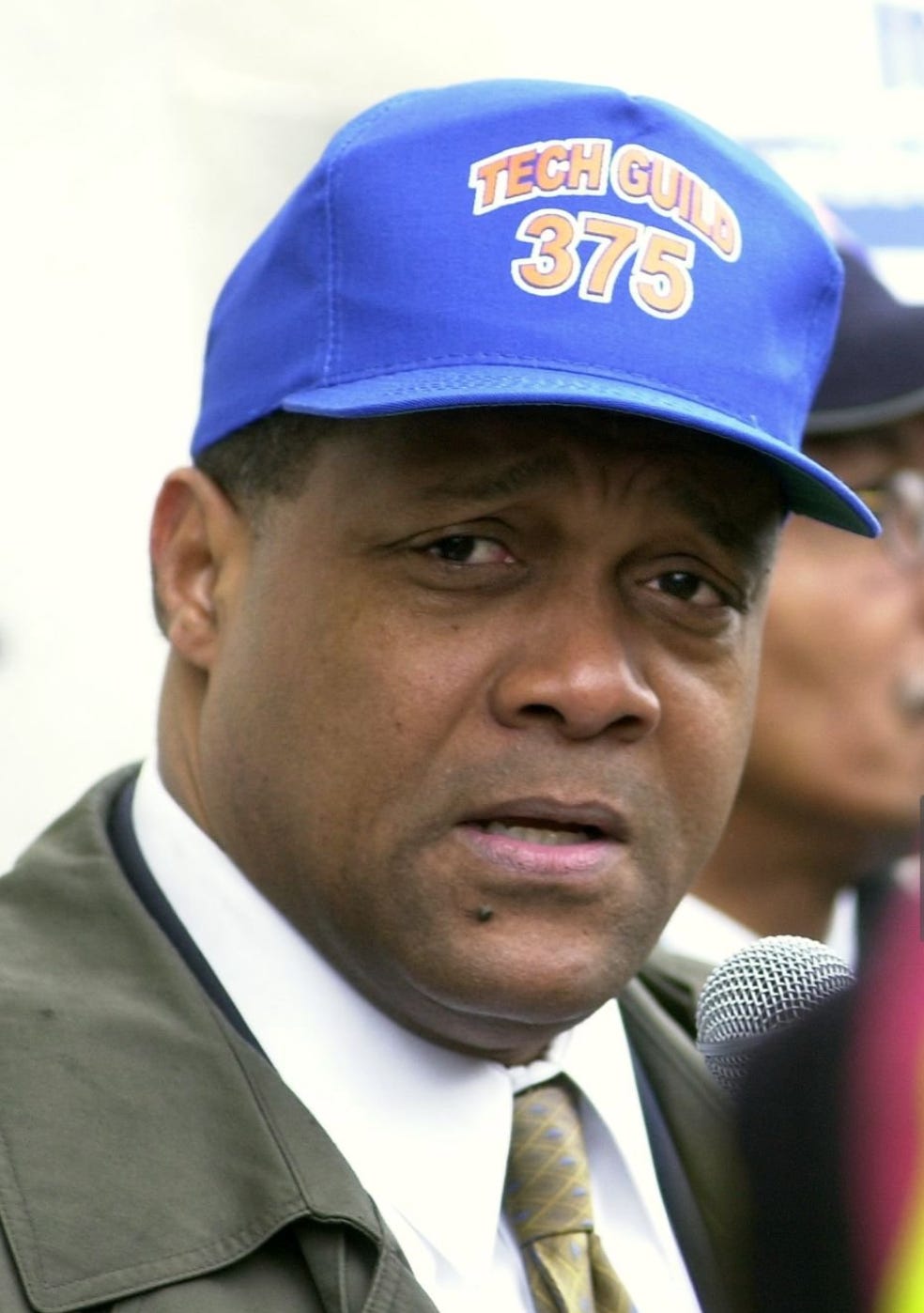
To pre-empt some of the criticism this article will inevitably receive and to be fair to some of the folks who witnessed the administratorship, there is also an argument often made that Local 375 was placed under it in retaliation by DC 37 President Henry Garrido against Mike Troman. This was allegedly for trying to negotiate raises for 375 specific titles independently from DC37. This does follow a somewhat logical timeline, as the Guild was placed under administratorship after the new “fair” elections had taken place with the former president banned from seeking reelection. To add to this the administratorship lasted years longer than initially stated by AFSCME. However, AFSCME may have just not been able to resolve many of the underlying issues. One might even argue that AFSCME got tired of all the infighting and bickering and just gave up one day. Both Claude Fort and Michael Troman are strikingly similar in their “leadership” attitudes, anti-democratic behaviors, and their desire to alienate rank-and-file members and their voices from the local’s leadership.
Anyone who reads the AFSCME Judicial decision that laid out why the Guild needed to be put under administratorship will be sadly reminded of many of the internal issues of today. The 2016 Judicial Panel decision stated that John English, the appointed Administrator “testified that the chaos at these meetings has on occasion created gridlock that interfered with the ability of the local to conduct even routine business, such as the adoption of meeting minutes or the ability to maintain a quorum.”
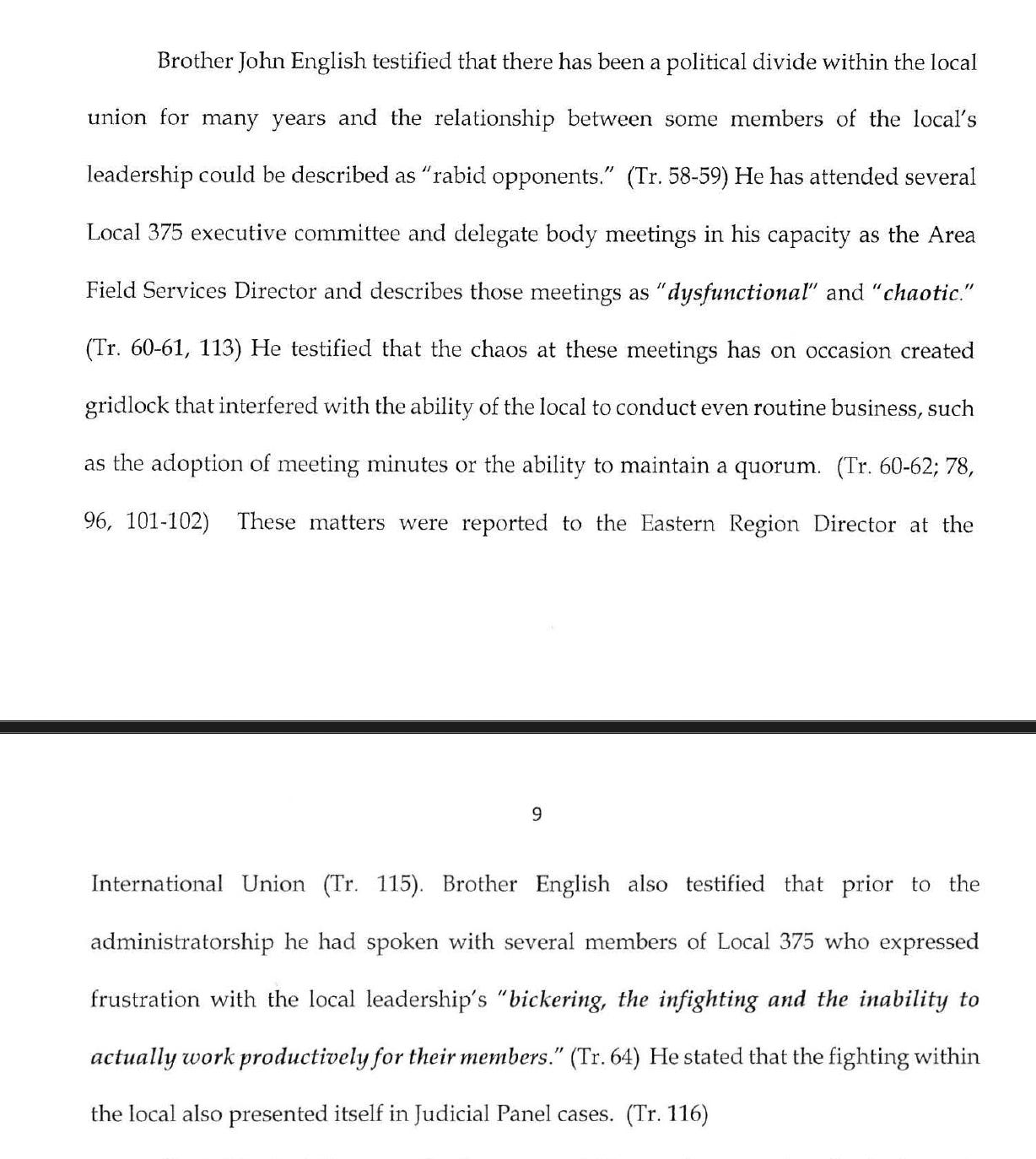
This sounds very familiar, as it is very rare that delegates meetings maintain a quorum and have probably never held one for the entirety of the meeting in the past few years. The local is also missing December 2024, January 2025, and March 2025 delegate meeting minutes. It was during one of those meetings that a resolution was passed to add a 30-minute President’s question and answer section to all general membership meetings. During both general membership meetings this past fall, the Q&A section was on the agenda—but its purpose was misinterpreted as being part of the guest speaker’s presentation. Understandably, the Executive Chair was out sick when this resolution was passed. However, that is all the more reason to have good record keeping. Had there been meeting minutes to reference, Dr. Paul could have reviewed and been aware of this new requirement enacted by the Delegates. Instead, the Q&A was begrudgingly agreed to as a concession in both meetings. This is also reminiscent of the administratorship as John English also cited the local’s inability “to protect the rights of the membership He also stated that binding decisions made by the delegate body and the executive committee are routinely ignored and that this in effect nullifies the participation of the membership.” The executives of the Guild should be able to remember one of two resolutions that was passed in the previous year (the other one being a resolution to hold hybrid meetings, which took nearly six months for the Local to figure out how to schedule at DC37 headquarters). The Local is violating its own constitution for maintaining clear and accurate minutes; DC37 Constitution Article IV Section 5 states “The secretary shall keep or cause to be kept accurate minutes of every council meeting which shall reflect all transactions at such meetings and record the vote on all decisions”. The minutes cannot “reflect all transactions at such meeting” when the secretary is not keeping track of which delegate is asking questions, who is making motions and other elements of parliamentary procedure during delegate meetings and especially during executive meetings.
To add to the dysfunction, the Guild’s Finances have and continue to be a mess. I would like to preface this as not a personal attack against anyone, but a sober accounting of the current state of affairs and what led the Local to this situation. The state of the finances, while not threatening the solvency of the Local, do put it on the edge of a cliff for administratorship. To start as stated in the Local 375 Constitution, Article XII, Section 5 (Treasurer’s Duties): “The treasurer shall keep an accurate record of receipts and disbursements and shall, once each month, submit to the board of delegates, a monthly operating statement of the financial transactions of the Guild for the previous month”. This monthly reporting did not happen during all of 2024 or 2025 despite it being a required duty of the Treasurer in the constitution. The Guild also went through all of 2024 without an approved budget. In the November 2024 Delegates meeting, the treasurer submitted the 2024 budget to be approved by the Delegates. At this point, the year was almost over and the vote to approve the budget failed due to frustration with the lack of details in it and the fact it took so long. While the Local can operate without a budget approved by the delegates there are only certain things the Local can spend money on until one is approved.
The president and executive board may vote for emergency spending allocations between delegate meetings, but the president can only approve up to $1,000 dollars in spending unilaterally. That expense must then be reported at the following delegates meeting Article XII Section 1: “The president is empowered to make expenditures not exceeding a total of $1,000.00 for matters requiring immediate action between meetings; such expenditures shall be reported to the executive committee at its next meeting.” It is unclear if the executive board met and approved a preliminary budget during 2024 like they did in the summer of 2025. That said, when the 2024 budget was retroactively approved in early 2025, the 2024 actuals were not provided to the delegates. Two major expenses that were not approved by a delegate vote or with an approved budget were the hiring of Jordan, the new accountant, and the re-signing of the office lease. Jordan was hired in the Spring of 2025 though the Guild’s executive board did not even approve their budget until the summer.
In addition to these major financial moves, Article XVIII Section 4 states; “A majority of the board of delegates only, may authorize the payment of a stipend from the Guild Treasury to Guild officers, officials, or chapter presidents.” This provision means that the Guild has been in violation of their own constitution if any of the Guild’s officers had been paid their stipends in most of 2024 and 2025. Hard work should be compensated but that compensation should also not be in violation of the Guild constitution. The Delegates are the highest authority per the constitution and all spending decisions must go to a vote and be approved by the delegates. This is why it was concerning to many when the thoroughly incomplete 2025 budget was “approved” over the summer by the executive board consisting of just chapter presidents and Guild Executives. As of today (December 14th, 2024) actuals have yet to be shared with delegates. The 2025 budget has yet to be voted on, mostly because meetings are so long and dysfunctional that a quorum cannot be reached.
A major component of the charges filed by Troman’s slate and others were charges related to Guild elections. This is another area where the executive leadership today has continued to fail at competently carrying out their duties. While local-wide elections are scheduled for next year, issues have already arisen during this year’s chapter elections. From Mike Troman and Dr.Paul endorsing candidates in their capacity as Guild officers to just plain ignoring AFSCME election rules things do not bode well.
The part of this year’s chapter elections that is of almost equal concern as the previously mentioned financial issues is that of the Guild’s interpretation of the elections rules. The President and Executive Committee members have committed a violation of the AFSCME International Constitution by knowingly and deliberately enforcing a local rule that systematically prevents the immediate installation of newly elected Chapter Officers and Delegates, which has denied them their right to hold office promptly. The AFSCME International Constitution states; Appendix D, Section 2(F) (Elections Code): “In any case where there is only one nominee for office, such nominee shall be declared elected. In all other cases, election shall be by secret ballot.” While the vast majority of positions across the chapters have been uncontested these nominated and presumed elected members have been prevented from taking office because the Local 375 Constitution states that they; “shall be installed at the first meeting in the month of January following the election.” This is in direct conflict with what is stated in the AFSCME constitution which is supposed to take precedence when there is a discrepancy between subordinate documents such as the DC37 or Local 375 constitutions. The AFSCME Election Manual explicitly acknowledges conflicts with subordinate constitutions and clarifies that the installation of elected officers must not be delayed: “Some local union constitutions have provisions that would seem to provide for a delay of anywhere from a few days to a couple of months between completion of the election and the installation of the new officers. No such provision is valid. Those elected must be installed immediately.” This issue has been raised at delegates meetings, but it has been dismissed without any investigation with the reasoning: “If you have a problem, take it up with AFSCME”. So attached is a formally written complaint for anyone interested in reading the specific legalese associated with this charge. All it takes is someone printing it out and mailing it via certified mail to “take it up with AFSCME”.
Truly nothing has changed since administratorship and while the past president might have been a “fraud,” the men who replaced him clearly are no different. They may come from a different century where their incompetence and self serving dealings pale in comparison to other Local 375 scandals, but this local should not strive to just be better than the other guy—it should actually be a functioning union that represents its members.